Hazardous Items in a New Jersey Estate Cleanout: What Can't Go in the Dumpster
Every estate cleanout reaches the same moment: the furniture is sold, the keepsakes are boxed, and what's left is the basement shelf of paint cans, a medicine cabinet full of old prescriptions, two tube TVs, a propane tank by the grill and a box of thermostats and batteries in the garage. Most of that can't simply go in a rented dumpster or out to the curb in New Jersey. Some of it is banned from the trash by state law, some is dangerous for the crew and the hauler, and some just needs a different drop-off. This guide goes item by item through what New Jersey families usually find, what the rules say, and how to plan these items into the estate sale and cleanout so they don't hold up the closing.
| Item | Trash or dumpster? | Where it usually goes |
|---|---|---|
| TVs, computers, monitors, tablets, desktop printers | No: banned under NJ's e-waste law | Free DEP-listed collection site; home pickup for heavy sets |
| Latex (water-based) paint | Only once fully dried | Dry it out, then trash; donate usable paint |
| Oil-based paint, stain, varnish | No, even if hardened | County household hazardous waste program |
| Prescription medications | Last resort only, per FDA steps | Project Medicine Drop box, DEA Take Back Day, pharmacy kiosk |
| Needles and lancets | Not loose | Sharps container; check county, mail-back or special pickup |
| Propane, gasoline, pool and garden chemicals | No | County hazardous waste event; check container limits |
| Mercury thermostats, fluorescent tubes | No | County hazardous waste or fluorescent drop-off |
| Lithium-ion and rechargeable batteries | No (fire risk, per EPA) | Battery drop-off or county program |
| Refrigerators, freezers, window ACs | Only after refrigerant recovery | Hauler or scrap recycler that handles refrigerant |
Safety First, Before Anyone Starts Sorting
- Don't mix chemicals to 'consolidate' them. The EPA warns that incompatible household products can react, ignite or explode, and that mixed waste can become unrecyclable. Keep everything in its original, labeled container
- Unlabeled or leaking containers, bulging cans and anything you can't identify should be set aside, not poured out. County collection events commonly refuse unknown or unlabeled containers, so ask the county program or your fire department how to handle them
- Medications and needles should be gathered and secured on the first day, before estate sale staff, buyers or contractors walk through the house
- Keep propane cylinders and gasoline cans outside the house, upright and away from heat, until they go to a drop-off. Never put them in a dumpster or a compactor truck
Firearms and ammunition follow their own rules; read firearms and estate sales before any gun leaves the house. A buried or basement heating oil tank is a separate issue too; see clearing an estate home with an oil tank.
TVs, Computers and Printers: New Jersey Bans Them From the Trash
This is the rule that catches the most families. New Jersey's Electronic Waste Management Act bans the disposal of 'covered electronic devices' in the regular trash. The Department of Environmental Protection defines a covered device as a desktop or personal computer, a computer monitor, a portable computer, a desktop printer, a desktop fax machine, or a television sold to a consumer, and its FAQ confirms that tablets count as portable computers. In an older home that usually means a basement tube TV or two, a big-screen rear-projection set, an old desktop tower, a monitor and an inkjet printer.
- Drop-off is free for consumers. The DEP says collection sites operating under an approved manufacturer plan are not allowed to charge consumers for recycling covered devices, and it publishes a county-by-county list of collection sites each year
- Heavy sets have a pickup option. For covered devices weighing 50 pounds or more, or TVs with screens larger than 40 inches diagonally, the DEP's FAQ lists manufacturer and recycler programs that offer home pickup
- Other electronics aren't covered by the ban. Microwaves, DVD players, stereos and similar items aren't mandated for recycling under the law, though the DEP encourages reuse and recycling; your town or county may still collect them
- Wipe or remove the data first. Computers, tablets and phones often hold banking logins, tax returns and photos. Pull the drives or have them wiped before any device is sold, donated or recycled, and see our guide to digital accounts and passwords
Paint, Stains and Finishes: Latex and Oil-Based Are Handled Differently
A lifetime of touch-up paint is the single most common hazardous item in a cleanout. The first step is telling the two kinds apart. The Morris County Municipal Utilities Authority (MCMUA) explains that latex paint is labeled as latex or says to clean up with water, while oil-based paint may be labeled 'alkyd', 'contains solvents', 'clean up with mineral spirits' or 'combustible.'
- Latex (water-based) paint: MCMUA says it can go out with the ordinary trash once it is completely dry. Let small amounts dry in the open can; for larger amounts, mix in kitty litter or shredded newspaper. Don't put liquid paint in the trash or down a drain
- Oil-based paint, stain and varnish: MCMUA says oil-based paint, hardened or not, cannot be disposed of in the trash and should go to a household hazardous waste program. Don't try to dry it out; the solvents are air pollutants
- Usable paint can be donated. MCMUA suggests offering reasonable quantities of good paint to a community organization or theater group, and gives a simple test: paint a small patch, let it dry 48 hours, and see whether masking tape pulls it off
- Very old paint deserves extra care. MCMUA notes that old oil-based and marine paints may contain lead, mercury, chromium or cadmium, and says paint with toxic metals should not be used up or given away
- Empty cans: MCMUA says they may be accepted in scrap metal recycling, or can go in the trash with the lids off so the hauler can see they're empty
- Expect county events to refuse latex. Union County's household hazardous waste events, for example, state plainly that latex paint will not be accepted
Prescription Medications: Secure Them First, Then Use a Take-Back
Prescription drugs can't be sold at an estate sale, and an unattended medicine cabinet during a public sale is a real risk. Collect every bottle, patch and inhaler on the first day and keep them locked up or off site. The FDA says the best way to dispose of most unused or expired medicines is a drug take-back program.
- Take-back boxes and events. In New Jersey, Project Medicine Drop puts secure drop boxes, mostly at police departments, around the state, and the Division of Consumer Affairs publishes the locations. The DEA also runs National Prescription Drug Take Back Days, and the FDA notes some pharmacies have drop-off kiosks or mail-back envelopes
- Flush only what's on the FDA flush list. The FDA says not to flush medicine unless it appears on its flush list. Fentanyl patches are one example of a product with flushing directions, because a lot of medicine stays in a used patch
- Household trash as a last resort. If no take-back is available, the FDA's steps are: take the drugs out of their containers, mix them with something unappealing such as used coffee grounds, dirt or cat litter, seal the mixture in a bag or container, put it in the trash, and scratch personal information off the empty bottles
- Inhalers and aerosols: the FDA notes they can be dangerous if punctured or burned, and says to read the handling instructions and ask your local trash and recycling facility
Clearing a Parent's Home in New Jersey?
Tell us about the house and your timeline, and we'll match you with New Jersey estate sale companies. Ask each one, in writing, what their sale and cleanout include and how they handle paint, electronics and appliances. Free, no obligation.
Get Matched FreeNeedles, Lancets and Other Sharps
Insulin pens, lancets and syringes are common in a parent's home and dangerous for anyone sorting bags by hand. The FDA recommends putting used sharps in a sharps disposal container right away and getting rid of the container when it's about three-quarters full, following community guidelines. Options the FDA lists include household hazardous waste sites that accept sharps containers, mail-back programs for FDA-cleared containers (usually for a fee), and residential special-waste pickup. Check first: Union County's collection events list medical sharps among the items not to bring.
Propane, Gasoline, Pool and Garden Chemicals
Garages and sheds hold the most volatile items in the house: grill propane cylinders, gas cans for the mower, kerosene, pool chlorine, pesticides and herbicides, antifreeze and motor oil. These are classic household hazardous waste, and they belong at a county collection rather than in a dumpster.
- County programs take most of it. Union County's events, for example, list propane tanks, gasoline, motor oil and filters, antifreeze, pesticides and herbicides, pool chemicals, corrosives and cleaners, aerosol cans, fire extinguishers and tires (with a per-household limit) among accepted materials
- Watch the size and container limits. Union County won't accept containers larger than five gallons, empty containers, unknown or unlabeled containers, or pressurized gas cylinders such as welding gas and oxygen.
- Full, usable propane cylinders can sometimes be sold or given away with the grill, but only if the buyer takes them off the property that day
Mercury Thermostats, Fluorescent Tubes, Smoke Detectors and Batteries
These are small and easy to toss by accident. Older round wall thermostats often contain a mercury switch, fluorescent tubes and compact bulbs contain mercury, and some smoke detectors and batteries need a separate route.
- Mercury items: Union County's events accept thermostats, mercury switches and unbroken fluorescent bulbs, and Union also runs free fluorescent-tube recycling at many municipal drop-off sites. MCMUA lists mercury, fluorescents and smoke detectors among the materials its program manages
- Batteries: Union County's events accept batteries but not ordinary alkaline batteries. The EPA says lithium-ion batteries shouldn't go in household trash or curbside recycling bins because they can cause fires; take them to a battery drop-off instead
- Old car and boat batteries: MCMUA lists auto and boat batteries separately from household batteries
Refrigerators, Freezers, Dehumidifiers and Window Air Conditioners
Appliances that still hold refrigerant are governed by federal rules under Section 608 of the Clean Air Act (40 CFR Part 82, Subpart F). The EPA explains that for household refrigerators, freezers and window air conditioners, the final person in the disposal chain, such as a scrap metal recycler or landfill, is responsible for making sure the refrigerant is recovered before final disposal. If an appliance arrives already empty, that recycler must keep a signed statement giving the name and address of whoever recovered the refrigerant and the date. In practice, ask any hauler or cleanout company how they handle refrigerant appliances before you sign, and don't let anyone cut the lines to 'empty' a fridge.
How to Plan These Items Into the Estate Sale and Cleanout
The families who close on schedule treat hazardous items as their own short project, started early, rather than as the last thing in the basement.
- Walk the house with a box and a list. Basement shelves, under the kitchen and bathroom sinks, the garage, the shed, closets and the medicine cabinet. Group items by route: e-waste, county hazardous waste, medications, sharps, appliances
- Check your county's calendar early. Collection days are often seasonal; Union County's 2026 events ran from April through October. If the cleanout falls in winter, ask whether your county has a permanent facility or an off-season option, or hold items safely until the next event
- Ask your estate sale company exactly what it will and won't remove. Many companies sell what they can and arrange a cleanout for the rest, but hazardous waste is usually excluded from a standard broom-clean. Get it in the contract. Our estate sale company contract checklist covers this
- Price the leftovers into the cleanout quote. Separate trips for e-waste, paint and appliances add time, which is why estate cleanout costs vary so much from house to house
- Keep receipts and notes. If the house is being sold, a simple record of where the oil-based paint, chemicals and electronics went is useful for the executor's file
For the rest of the house, see what not to sell at an estate sale, how an estate sale compares with junk removal, what drives estate cleanout cost, and the estate sale company contract checklist. If computers and phones hold a parent's accounts, read digital accounts and passwords in an estate cleanout before anything is recycled. Rules and collection schedules vary by county and change from year to year, so confirm with your county program before drop-off. This page is general information, not legal or environmental advice.
Sources
- NJDEP: E-Waste Frequently Asked Questions (covered electronic devices, disposal ban, free collection, home pickup), January 18, 2024
- NJDEP: Covered electronic device collection site list
- Morris County MUA: Household hazardous waste FAQ, paints and stains
- County of Union: Household Hazardous Waste events, accepted and refused materials (2026 schedule)
- FDA: Where and How to Dispose of Unused Medicines
- NJ Division of Consumer Affairs: Project Medicine Drop box locations
- FDA: Best Way to Get Rid of Used Needles and Other Sharps
- EPA: Stationary Refrigeration Safe Disposal Requirements (Clean Air Act Section 608)
- EPA: Household Hazardous Waste (HHW)
- EPA: Used Lithium-Ion Batteries
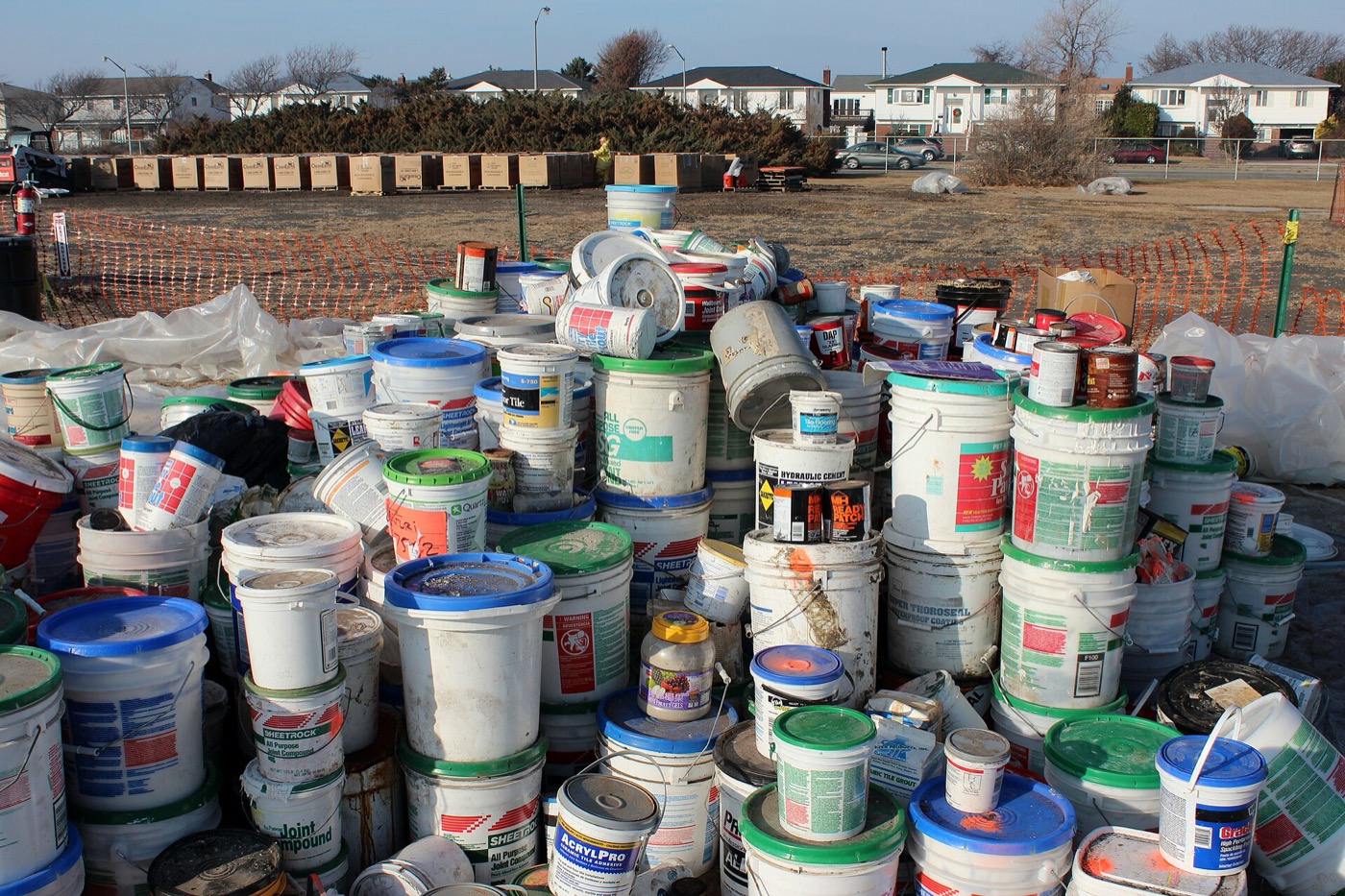
- Photo: U.S. EPA / Jeanethe Falvey, Lido Beach, N.Y., 2012 (public domain), via Wikimedia Commons
Frequently Asked Questions
Can I throw an old TV or computer in the dumpster in New Jersey?
No. New Jersey's Electronic Waste Management Act bans disposal of covered electronic devices in the trash. The DEP defines them as desktop or personal computers, computer monitors, portable computers including tablets, desktop printers, desktop fax machines and televisions sold to consumers. Take them to a collection site on the DEP's list, which can't charge consumers for covered devices under an approved manufacturer plan, or use a listed home pickup program for very heavy sets.
How do I get rid of old paint from a parent's house in NJ?
Sort it first. According to the Morris County MUA, latex (water-based) paint can go in the regular trash once it is completely dried out, using kitty litter or newspaper for larger amounts. Oil-based paint, stain and varnish, hardened or not, can't go in the trash and should go to a county household hazardous waste program. Many county events don't accept latex paint, so check the rules before you load the car.
What should we do with a deceased parent's prescription medications?
Gather and secure them right away, and never sell or give them away. The FDA says a drug take-back program is the best option for most medicines. In New Jersey, Project Medicine Drop boxes, mostly at police departments, are listed by the Division of Consumer Affairs, and the DEA holds National Prescription Drug Take Back Days. If no take-back is available, follow the FDA's trash steps, and flush only medicines on the FDA flush list.
Will an estate sale or cleanout company take hazardous waste?
Usually not as part of a standard cleanout. Estate sale companies sell what they can, and cleanout crews generally exclude paint, chemicals, propane, medications and sharps. Some will gather items for you or coordinate a specialty hauler for an added charge. Ask before you sign and get the answer in writing.
What happens to an old refrigerator or window air conditioner from the estate?
Federal rules under Section 608 of the Clean Air Act require that refrigerant be recovered before these appliances are finally disposed of. The EPA places that responsibility on the final person in the disposal chain, such as a scrap recycler, who must keep a signed statement if the appliance arrives already empty. Ask your hauler how they handle refrigerant appliances, and don't cut refrigerant lines yourself.
Get Matched With an Estate Sale Company
Compare walkthroughs and written terms from New Jersey estate sale companies, including what's left for the cleanout and who handles it.
Get Matched Free